
Predictive Leadership™
Most leadership development starts at Action. Predictive Leadership starts earlier.
Why do capable leaders and teams miss important signals, delay difficult decisions, or discover too late that the organisational picture was incomplete?
Predictive Leadership™ explains how judgement forms before action becomes visible.
It examines what enters attention, how events are interpreted, what leaders become motivated to pursue or protect, and how those processes shape the response that follows.
By making that sequence visible, leaders and teams can test assumptions earlier, preserve wider judgement under pressure and create more choice before action locks in.
Why this matters beyond the individual leader.
Predictive Leadership™ applies at every organisational layer. Individuals notice and interpret signals. Teams form shared accounts. Managers decide what to escalate. Executives and boards act on what finally reaches them. At each stage, some information is amplified, some is softened and some moves out of view. By the time an issue reaches a senior decision-making group, the available version of reality may already reflect multiple acts of attention, interpretation and protection. Predictive Leadership™ helps leaders examine not only the decision in front of them, but how that version of reality was created.
The Predictive Leadership Model.
Predictive Leadership describes the process through which leaders become aware of what matters, make sense of situations, and decide how to act.
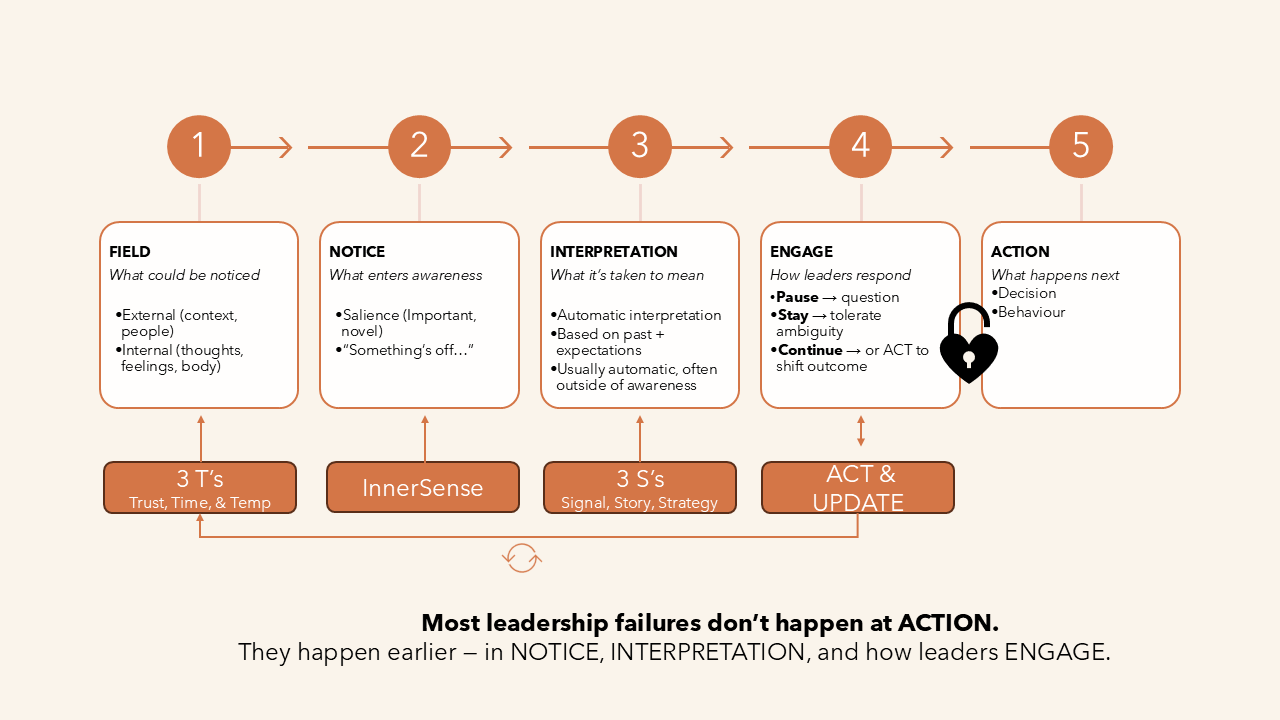
The model explains how leaders become aware of what matters, how they make sense of complex situations, and why they do not always act on what they already know.
Predictive Leadership begins with the wider Field — everything that could be noticed. From that field, some signals enter awareness, are interpreted, and evoke a motivational response. That response influences whether leaders remain open enough to question assumptions, update their understanding, and respond deliberately.
When pressure rises, awareness can narrow, interpretations can become more fixed, and action can become increasingly automatic.
Most leadership failures do not begin at Action.
They begin earlier — in what is noticed, how it is interpreted, and whether leaders remain open enough to update.
Developed through doctoral research into leadership awareness, Predictive Leadership provides a practical framework for improving decision quality under pressure.
The Five Elements of Predictive Leadership.
Predictive Leadership describes five interconnected processes that shape how leaders become aware of what matters, make sense of situations, and decide how to act.
-
The Field includes everything potentially available to awareness: people, relationships, pressures, opportunities, assumptions, emotions, bodily signals and environmental cues.
Leaders never act on the whole field. They act on the parts that become visible and meaningful to them.
The breadth and quality of the field available for attention shape the quality of the judgement that follows.
A useful question: What could be noticed that is currently outside the frame?
-
Not everything in the field is noticed.
Attention is selective.
Under pressure, leaders may become drawn towards what feels most urgent, threatening, familiar or important, while weaker but potentially significant signals move out of view.
Notice is where the available version of reality begins to take shape.
A useful question: Which signals are attracting attention—and which may be receiving too little weight?
-
Leaders do not respond directly to events.
They respond to the meaning they construct from them.
Interpretation is shaped by experience, expectations, assumptions, values and existing narratives. The same situation can therefore produce very different decisions depending on the story that becomes convincing.
A useful question: What interpretation has become persuasive, and what evidence might challenge it?
-
Leaders do not interpret situations from a neutral position.
Their motivating state influences what feels important, safe, threatening or possible—and therefore what they become driven to pursue, protect, avoid, tolerate or change.
When leaders remain sufficiently open, they can tolerate uncertainty, question assumptions and update their understanding.
When protective responses take over, attention narrows, interpretation becomes more fixed and alternative responses become harder to access.
Predictive Leadership™ describes these restrictive protective patterns as Heart Locks because they reduce the leader’s capacity to remain open to new information, different perspectives and alternative action.
A useful question: What are we now trying to achieve, protect or avoid—and how is that shaping what we can see?
-
Action is the visible outcome of everything that comes before it.
Decisions, behaviours, conversations, avoidance, escalation, delegation and strategy emerge from the interaction of Field, Notice, Interpretation and Engage.
By the time action becomes visible, the processes shaping it may have been operating for some time.
Action also changes the Field: it affects what happens next, what others notice and what information becomes available in return.
A useful question: What response is this interpretation making more likely, and what will that action make visible next?
From explanation to inquiry
Predictive Leadership™ explains the process.
InnerSense helps make that process visible.
Predictive Leadership describes how attention, interpretation, motivating state and action interact before a decision becomes visible.
InnerSense provides a practical lens for examining that process in a real situation—revealing where attention became concentrated, what may have moved out of view and which interpretations or protective responses shaped what happened next.
Used with individuals, teams or organisations, InnerSense helps turn an abstract model into something that can be questioned, tested and worked with.
Research foundations.
Predictive Leadership™ was developed through doctoral research into how leaders become aware of what matters in complex environments.
The research combined in-depth qualitative studies with a quantitative study involving more than 300 leaders, examining how attention, interpretation, motivation and embodied signals shape judgement over time.
This research now informs the practical tools used across Strategic Attention Partnerships, team diagnostics, Labs and Decision Quality Under Pressure.