
InnerSense.
See what is shaping judgement and performance before it becomes a visible problem.
InnerSense is a research-informed lens for understanding where attention is concentrated, what may be moving out of view and how interpretation is shaping action under pressure.
It helps leaders and teams examine the dynamics beneath delayed decisions, strained relationships, defensive meetings, weak delegation, stalled change and disappointing execution.
The visible problem is rarely the whole problem.
What looks like a process or performance gap may also involve narrowed attention, untested assumptions, protective responses, strained connections, or competing demands that have become difficult to hold in view.
InnerSense makes those patterns available for inquiry.
The field of awareness.
Leaders never notice everything equally.
At any moment, some aspects of a situation become vivid while others fade into the background. What enters attention shapes what becomes thinkable, discussable and actionable.
InnerSense maps that field across five interconnected performance levers:
Drive, Safety, Balance, Connection and Sense.
The shape of the field does not measure performance or produce a fixed profile. It indicates what appeared most available in a particular situation—and what may need to come back into view.
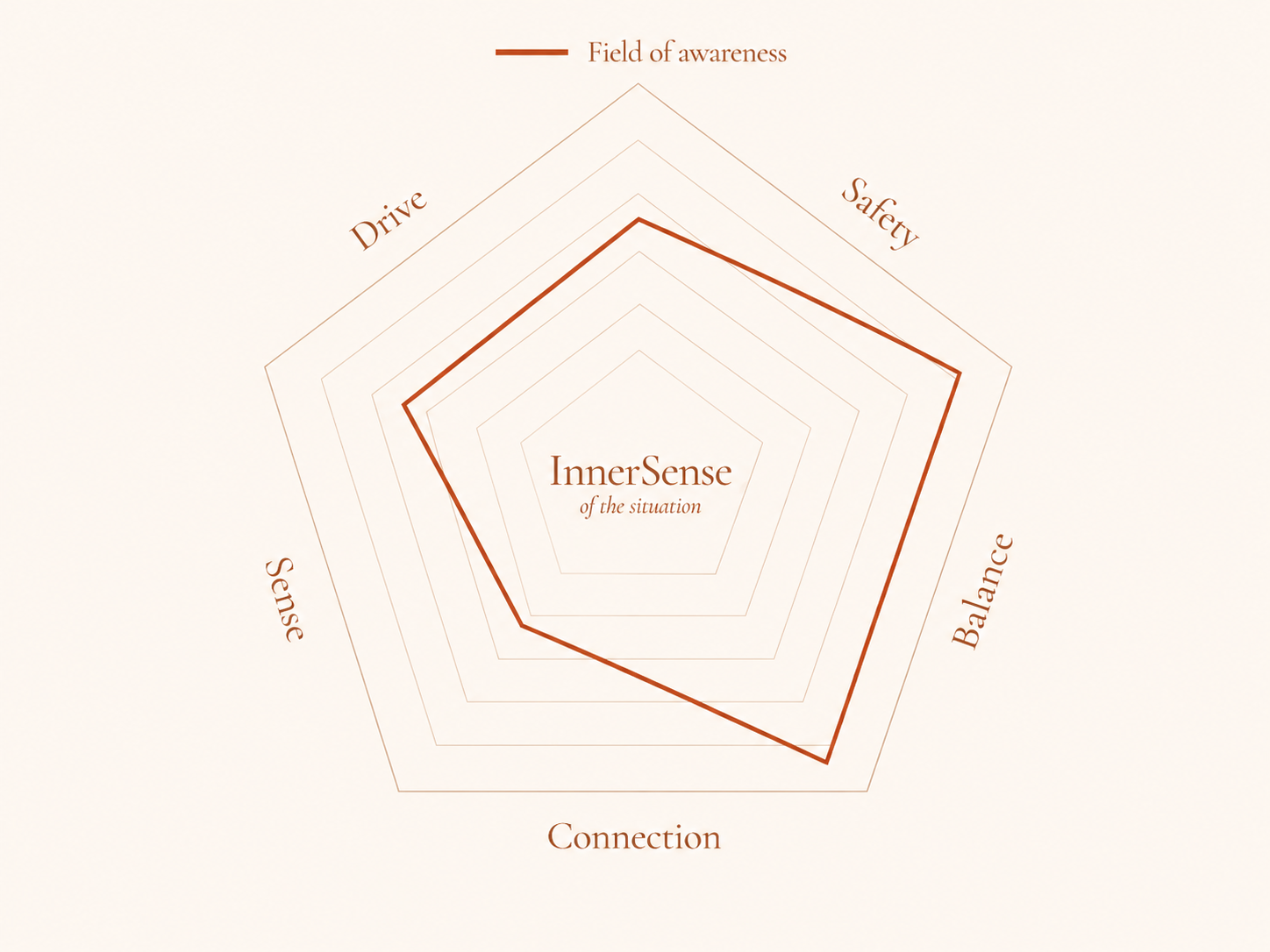
The five Performance levers.
What leaders learn to notice.
The five levers show where attention, energy and meaning are concentrated—and where they may need to shift.
They are not separate categories. They interact continuously.
A leader may have strong Drive while Safety becomes more prominent. A team may appear well connected while Balance weakens. An organisation may have strategic clarity while Sense becomes distorted under pressure or overload.
-
Drive shapes what people move towards—solving, achieving, proving, contributing or developing others.
When clear, it supports purpose, energy and ownership.
Under pressure, Drive can become over-efforting, rescuing, proving or pushing beyond what the situation needs.
A useful question: What are we trying hardest to achieve—and what might that effort be obscuring?
-
Safety shapes how open, reactive or defensive people become when something important feels uncertain or threatened.
When there is sufficient safety, people can remain open to complexity, challenge and feedback.
When Safety becomes compromised, behaviour may narrow into control, avoidance, silence, compliance or self-protection.
A useful question: What currently feels at risk, and how might that be shaping what people feel able to say or do?
-
Balance shapes how leaders and teams hold competing needs: people and task, self and others, delivery and strategy, urgency and sustainability, doing and delegating.
When Balance is maintained, judgement is steadier, responsibility is clearer and performance is more sustainable.
Under pressure, capable people may over-carry, priorities can blur and immediate demands can crowd out wider consequences.
A useful question: What are we prioritising—and what important need may be receiving too little attention?
-
Connection is the quality of social awareness within a team or system.
It includes perspective-taking, reading the room, building trust and understanding what may be shaping other people’s responses.
When Connection is strong, teams coordinate more effectively, test assumptions and speak more honestly.
Under pressure, assumptions can replace inquiry, friction can increase and important perspectives or signals may remain unspoken.
A useful question: Whose perspective are we relying on, and whose experience may not yet be influencing the conversation?
-
Sense shapes how leaders and teams understand what is happening.
It includes judgement, pattern recognition and the ability to notice when something is moving off track before it becomes obvious. It also involves distinguishing signal from noise when information is excessive, fast-moving, ambiguous or incomplete.
When Sense is clear, leaders test interpretations, recognise meaningful patterns and respond earlier.
Under pressure, weak signals may be missed, noise can dominate and familiar narratives can take over before alternatives have been explored.
A useful question: What story is currently making sense of the situation—and what evidence might support or challenge it?
InnerSense is a practical application of Predictive Leadership™.
Predictive Leadership explains how judgement forms through Field, Notice, Interpretation, Engage and Action.
InnerSense helps examine that process in a real situation by asking:
what was driving action;
what felt important to protect or avoid;
what competing needs were being balanced;
whose perspective and experience remained visible;
what sense was being made of events.
The resulting patterns are treated as working hypotheses, not diagnoses or definitive judgements.
They can be explored with an individual leader, across a team or as part of a wider organisational engagement.
From reflection to action.
decisions are becoming slower, more reactive or repeatedly revisited;
challenge, weak signals or alternative perspectives are not surfacing;
responsibility is becoming over-centralised or difficult to delegate;
change has technically launched but is not landing;
capable people are working hard while coordination, clarity or ownership remain weak.
InnerSense is useful when:
The result.
Leaders see more clearly what is shaping judgement before they act.
Teams develop a shared language for discussing pressure, interpretation and performance without blame.
Organisations surface the hidden patterns contributing to slow decisions, repeated friction, weak ownership and stalled change.
Work with InnerSense
InnerSense is applied through:
Strategic Attention Partnerships;
Pressure & Performance Diagnostics;
Strategic Attention Labs;
Decision Quality Under Pressure;
wider organisational engagements.
Why InnerSense matters
Most organisations respond to performance problems mechanically.
They redesign processes, clarify governance, restructure teams or add tools. Sometimes that helps. But the deeper pattern can remain untouched.
Under pressure, attention narrows, protection increases and interpretation becomes more selective. In complex environments, noise can be mistaken for relevance, speed for clarity and activity for judgement.
InnerSense helps surface those patterns before they harden into repeated friction, stalled change or hidden cost.
See what may be shaping judgement beneath the visible issue.
Explore how InnerSense can be applied with a leader, team or organisation.